
 Image 1 of 1
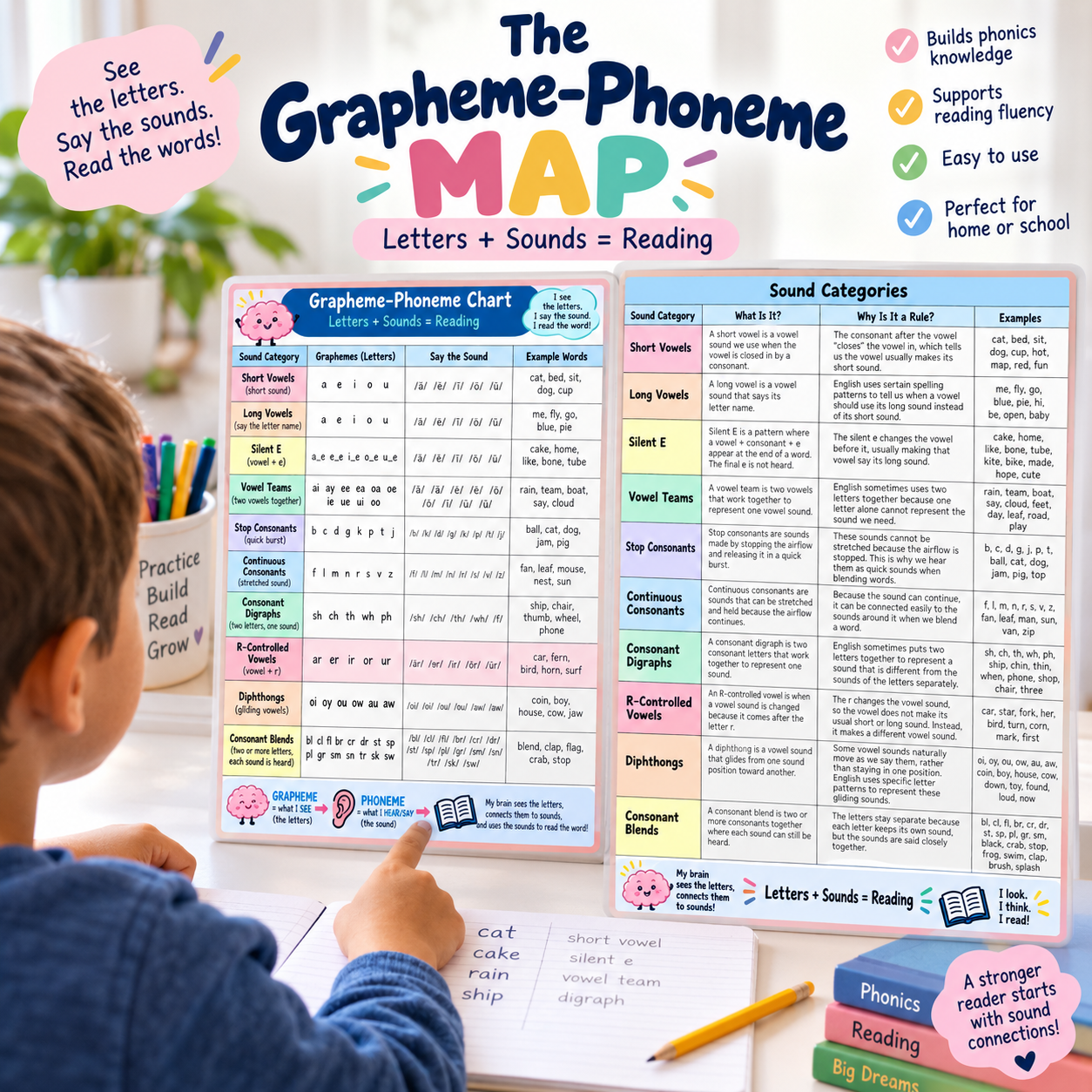
The Grapheme–Phoneme Map gives learners a visual overview of the sound and spelling patterns they encounter when reading. Instead of memorizing individual rules separately, learners first build a big-picture understanding of how letters and sounds work together to form words.
The map introduces 10 major sound and spelling categories:
Short Vowels
Long Vowels
Silent E
Vowel Teams
Stop Consonants
Continuous Consonants
Consonant Digraphs
R-Controlled Vowels
Diphthongs
Consonant Blends
For each category, the map explains:
What Is It?
A simple explanation of the sound or spelling pattern.
Why Is It a Rule?
An explanation of how the pattern helps the brain determine the sound represented by the letters.
Examples
Words that demonstrate the pattern in action.
How to Use It
Learners are encouraged to examine the words, notice patterns, and connect what they see (graphemes) to what they hear and say (phonemes).
Questions such as:
“What do you notice about these words?”
“What letters are working together?”
“What sound does this pattern represent?”
“How are these words alike?”
“How are they different?”
“What rule helps your brain figure out this word?”
help develop pattern recognition, sound-symbol connection, and word-reading awareness.
The Goal
The goal is to help learners understand why words are read the way they are, rather than relying only on memorization or guessing.
See the letters → Connect them to sounds → Recognize the pattern → Read the word
The Grapheme–Phoneme Map gives learners a visual overview of the sound and spelling patterns they encounter when reading. Instead of memorizing individual rules separately, learners first build a big-picture understanding of how letters and sounds work together to form words.
The map introduces 10 major sound and spelling categories:
Short Vowels
Long Vowels
Silent E
Vowel Teams
Stop Consonants
Continuous Consonants
Consonant Digraphs
R-Controlled Vowels
Diphthongs
Consonant Blends
For each category, the map explains:
What Is It?
A simple explanation of the sound or spelling pattern.
Why Is It a Rule?
An explanation of how the pattern helps the brain determine the sound represented by the letters.
Examples
Words that demonstrate the pattern in action.
How to Use It
Learners are encouraged to examine the words, notice patterns, and connect what they see (graphemes) to what they hear and say (phonemes).
Questions such as:
“What do you notice about these words?”
“What letters are working together?”
“What sound does this pattern represent?”
“How are these words alike?”
“How are they different?”
“What rule helps your brain figure out this word?”
help develop pattern recognition, sound-symbol connection, and word-reading awareness.
The Goal
The goal is to help learners understand why words are read the way they are, rather than relying only on memorization or guessing.
See the letters → Connect them to sounds → Recognize the pattern → Read the word